

Layoff Lessons: Part 2 of 3
A short series on what two layoffs taught me, so you don’t have to learn it the hard way.
Missed Part 1? Read I got laid off on my day off.
Losing a job is hard enough. It messes with your head and sets your career back. But the money is what keeps you up at night.
When the paycheck stops, life gets scary fast. Can you pay the rent or mortgage? Buy groceries? Keep your kids in their activities? One surprise car repair can wipe out whatever savings you have left.
I worried about all of this both times I lost a job. Every time, I felt like a failure. I was frustrated and sad that I couldn’t provide for my family.
I knew something had to change. I couldn’t keep living like that.
One paycheck is a risk
When your job is your only income, everything depends on it. Food on the table. Heat and electricity. Netflix. Clothes for your kids. Lose the job, and life jumps to hard mode.
Layoffs aren’t rare anymore. Both times I got laid off, I was doing great work. My coworkers liked me. I was a real asset to the company. None of that mattered.
If this sounds scary, it’s supposed to. You never know when you’ll lose your job or when something big will happen at home.
That’s why I think you should start building another source of income now, before you need it.
Why I started a side business
In 2024, I started a side business. I had no idea how I’d make money. I just knew I had to figure it out.
First, I started this newsletter. Then in 2025, I started building apps and digital products. I made my first dollar from a digital product.
I’ve run a lot of experiments since then. I started six apps, finished two, and made $0. For me, it’s not just about the money, though. I want to do work I enjoy that also helps other people.
My side business has barely made any money so far. But imagine if I had never started back in 2024. I wouldn’t be where I am today.
This year, I started coaching. It’s been my best experiment yet. I finally found something that gives me energy, that I can see myself doing long-term, and that truly helps people.
I had to try other ideas before I got here. That’s the lesson. Building a business takes a lot longer than you think. So if you’re even a little interested, start now.
How to do it on the side
Let me be clear. Building a business while you have a full-time job and a family is a grind. Your patience will be tested. Most days, it’ll feel like you’re not making progress. And you’ll do a lot of context switching. It’s not for everyone. But for me, it’s worth the struggle.
Here’s how I’d start.
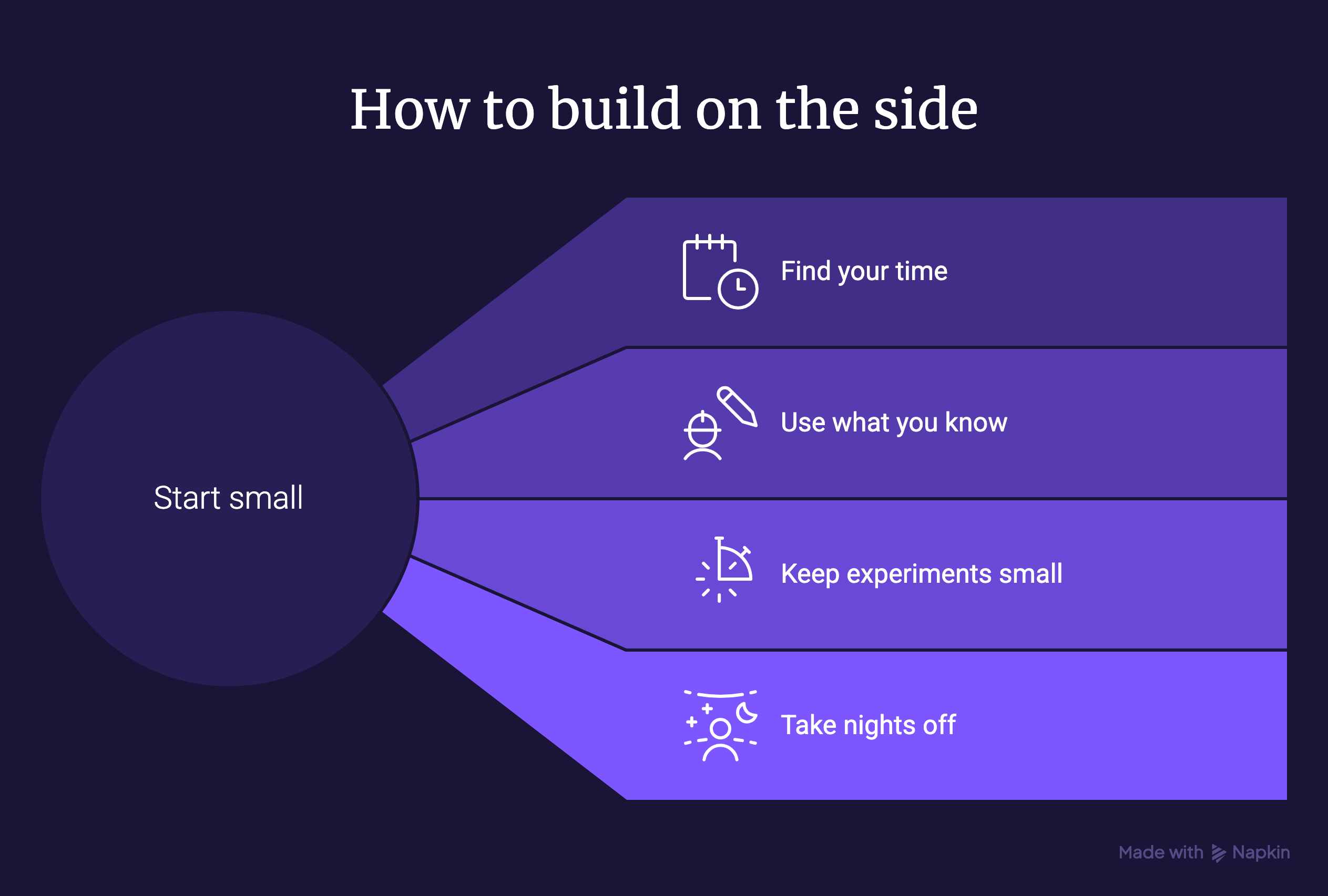
Find your time
Look at your calendar and see where your time actually goes each week.
When does your job start and end?
When do you like to exercise?
When do you drive your kid to practice?
Once you know your commitments, you’ll see your open time. Maybe it’s an hour before work. Maybe it’s lunch. Maybe it’s two hours after the kids go to bed. Weekends usually have the most open time, so use them to make real progress.
Here’s what my week looks like. Before work, I write LinkedIn posts, leave comments, and send messages. After work, I have coaching sessions. I write this newsletter in the evenings and on weekends.
That time has to come from somewhere. I give up time with family and friends, and time to relax. It’s worth it for now. But it’s a real trade-off, and you should know that going in.
Start with what you already know
You don’t need a brand-new skill. As an engineer, you already know how to build, solve problems, and explain hard ideas. That’s how I ended up building apps, writing this newsletter, and coaching other engineers.
Keep each experiment small
Want to build a SaaS app? Make a simple dev plan and break the work into small tasks. Want to start consulting? Figure out what you offer and who you help.
Turn most tasks into something you can finish in 30 to 60 minutes. That way, you make progress every week, even the busy ones.
Don’t wait for the perfect plan. If an experiment doesn’t work, you still learned something. Move on to the next one.
Give yourself nights off
You’re not a robot. Read a book, watch a show, spend time with your family. Do what gives you energy, because you’ll need it. Breaks also give your brain a rest from problem-solving, and they can unlock new ideas.
We all have a different relationship with money. It often takes a hard time to make you rethink how you earn it and spend it. For me, it took losing my job and realizing my only income was gone.
Building on the side takes sacrifice, discipline, and flexibility. It’s not easy. But it teaches you lessons you won’t learn anywhere else. And it opens doors that can get you closer to the life you want.
You don’t need a big plan to start. Pick one small experiment and give it a try this month.
What’s one skill from your job you think someone would pay for? Tell me in the comments.
Next time, I’ll share how layoffs changed the way I think about networking, and how to build your network before you need it.
Picking something small is key, and building from there. Also, something you enjoy :)
Thanks for sharing this.
There are a ton of stuff I've been putting off for a while now, all become I don't want to start small, thank you for helping me understand that sometimes the benefit is from the experience and not just the result.